The Light Eaters
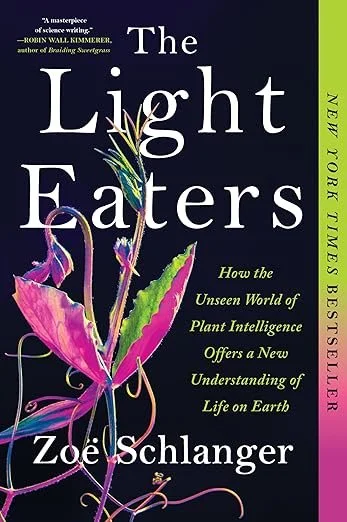
I recently came upon a great discovery! Thanks to a member of my meditation group, I picked up a copy of The Light Eaters: How the Unseen World of Plant Intelligence Offers a New Understanding of Life on Earth by Zoe Schlanger. This collection of findings in the field of botany dramatically awakens us to what is really going on in the world of plants and trees. To survive and thrive, even though they can’t move around because they are rooted, they have capabilities we have never heard about before. This makes us more aware that they are living and caring beings.
In the photsynthesis process, we have already known that trees and plants convert sunlight, carbon dioxide, and water into the sugars that feed them and the oxygen that feeds us. But now, the science of botany is making many major discoveries that expand our understanding of how they live.
Here are some ways that they are similar to us;
Some plants can “hear” a c atepillar chewing on their leaves so that they can set up defenses.
Some plants have the ability to store and recall information. For example, remembering what the weather was like last winter to decide whether to flower or create a fruit in the spring.
Plant roots have a type of vision that they use to decide whether they need to grow deeper.
Plants can change their growth pattern to adapt to their environment, and new data suggest that those changes can be passed on to the plant’s offspring.
Some plants “hire” ants to help protect them from predators and they “pay” them for this with syrup and lodging.
Here are some ways that they are different than us:
Some plants change the chemistry of their leaves when needed to make them unattractive to a foraging catepillar.
Some plants can send out an ethylene warning gas to warn other faraway plants that danger is coming their way.
Goldenrod plants can sense the airborne signals of the presence of nearby flies which allows them to jump start their immune system before the flies even land on them.
The look and scent of plant flowers are used to attract pollinators like a bee, bird, or butterfly to land on them to transfer pollen from the male part of the plants to the female part.
The rye plant changes its appearance to look like a farmer’s crop plant so it isn’t treated as a weed.
By using light sensors in its leaves, one vine can change its leaves’ shape, color, texture, and veins to imitate the leaves of four different trees.
By reading about these new discoveries, I have wonderfully expanded my view of nature. I am now beginning to actually see and feel that plants are caring beings that are my companions in this life journey. As a result, I now see the need to be with them and care for them as part of my family. We truly are all in this together!
